Whose Labor Built the Hill: Restoring the Voices of Enslaved Workers to Tunnel Hill's Story
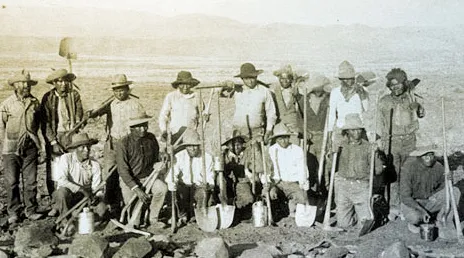
Photo: U.S. Reclamation Service, Public domain, via Wikimedia Commons
A heritage site is, at its most fundamental, a choice. Someone decided which stories to preserve, which artifacts to display, which names to inscribe on interpretive panels and which to leave blank. For most of American history, the choices made at sites like Tunnel Hill reflected the biases of the people doing the choosing—and the voices of enslaved and free Black workers who performed much of the physical labor that made such landmarks possible were among the most consistently excluded.
At the Tunnel Hill Heritage Center, that reckoning is ongoing. Curators, historians, and community partners have spent recent years working to restore a more complete account of the tunnel's construction—one that does not diminish the engineering achievement it represents, but insists on acknowledging who, in the most literal sense, dug it.
The Labor Behind the Landmark
Construction on the Western & Atlantic Railroad's Tunnel Hill bore began in the 1840s, a period during which the state of Georgia operated the railroad as a public enterprise. The labor force assembled for the project was, as was common throughout the antebellum South, composed in significant part of enslaved individuals—some hired out by their enslavers to the railroad for seasonal or project-specific terms, others assigned by the state through arrangements that generated income for slaveholders while providing the railroad with a controlled and coerced workforce.
State railroad records from the period, held in part at the Georgia Archives, document expenditures for "negro hire" alongside purchases of tools, powder, and timber. These entries are terse and transactional—they record costs, not people. Names rarely appear. Ages, origins, and the conditions under which these men labored are almost entirely absent from the official record.
Dr. Keisha Franklin, a historian of antebellum labor at the University of Georgia, has spent several years working with these fragmentary sources. "What the ledgers tell you is that the railroad knew exactly how much each enslaved worker's labor was worth in dollars and cents," she observes. "What they don't tell you—what they were never designed to tell you—is anything about the human beings themselves. Recovering that requires a different kind of historical work."
Reading Between the Lines
That different kind of historical work draws on a range of sources that traditional railroad history has often overlooked. Plantation records, estate inventories, and hiring contracts held at county courthouses across northern Georgia occasionally name individuals who can be cross-referenced with railroad labor records. Freedmen's Bureau documents from the postwar period, which captured testimony from formerly enslaved people across the South, include accounts from men who described working on railroad construction projects in the region during the 1840s and 1850s.
Oral histories collected by Works Progress Administration interviewers in the 1930s add another layer. Several interviews conducted in Georgia include references to tunnel construction, passed down through family memory across generations. These accounts are not without their limitations—memory is imperfect, decades had elapsed, and WPA interviewers worked within their own set of constraints and biases—but historians treat them as meaningful evidence when triangulated against documentary sources.
"You piece it together," Dr. Franklin explains. "A name in a hiring contract here, a description in a WPA narrative there, a death record in a county register that matches a location and a time period. It is painstaking work, and it is never complete. But every name you recover is a person restored to history."
Free Black Labor and a More Complicated Picture
The history of labor at Tunnel Hill also includes free Black workers, whose presence complicates any simple binary between enslaved and free. In the antebellum South, free Black individuals occupied a legally precarious and socially constrained position, subject to regulations that severely limited their mobility, occupational choices, and legal protections. Some worked alongside enslaved laborers on infrastructure projects, their freedom nominal in a context where coercion operated through law and custom as well as outright ownership.
Documentary evidence of free Black workers at Tunnel Hill is even sparser than that for enslaved laborers, in part because their presence was less economically legible to the record-keepers of the time. Recent scholarship has begun to address this gap, drawing on tax records, church registers, and community histories preserved by Black families and institutions in northern Georgia.
What the Heritage Center Is Doing
The Tunnel Hill Heritage Center has incorporated this evolving scholarship into its interpretive approach in several concrete ways. A dedicated exhibit panel within the main gallery now addresses the role of enslaved and free Black labor in the tunnel's construction, presenting documentary evidence alongside an honest acknowledgment of what the record does not—and cannot—tell us. The center's educational programming for school groups includes age-appropriate discussion of how historical records are created, who controls them, and whose experiences they tend to exclude.
For families visiting with children, this framing offers an unusually direct entry point into conversations about history, equity, and the responsibilities of memory. Staff educators at the center are trained to facilitate these discussions in ways that are accessible without being reductive—acknowledging complexity while making the core questions clear: Who built this? Why don't we know their names? And what does it mean that we are asking those questions now?
The center has also established a community research partnership with several historically Black churches and family associations in the Tunnel Hill area, whose members have preserved oral traditions and private documents that complement the official archival record. This collaboration is ongoing, and new information continues to surface.
An Invitation to Look Closer
For every visitor who walks through the tunnel's cool interior and marvels at the precision of its stone lining, the Tunnel Hill Heritage Center extends a quiet invitation: look closer. The engineering is real, and it is remarkable. But so is the human cost at which it was achieved. The men who swung picks in the mountain's darkness, who breathed the dust of blasting powder and hauled rubble by torchlight, left their labor in every foot of this structure—even when history did not leave their names.
Restoring those names, and those stories, is not a revision of Tunnel Hill's history. It is its completion.