Voices Carried Forward: Descendants of Tunnel Hill Share the Stories Time Almost Forgot
Photo: Luca Galuzzi (Lucag), CC BY-SA 2.5, via Wikimedia Commons
There is a particular kind of knowledge that does not survive in deed books or military rosters. It lives instead in the specific details — the color of a great-great-grandmother's apron, the sound a grandfather made when he did not want to answer a question, the way a family always set an extra place at the table on certain anniversaries without ever quite explaining why. This is the knowledge that oral history exists to recover, and it is the knowledge that descendants of Tunnel Hill's original community are now sharing with a new generation of listeners.
A Community Remembered in Fragments
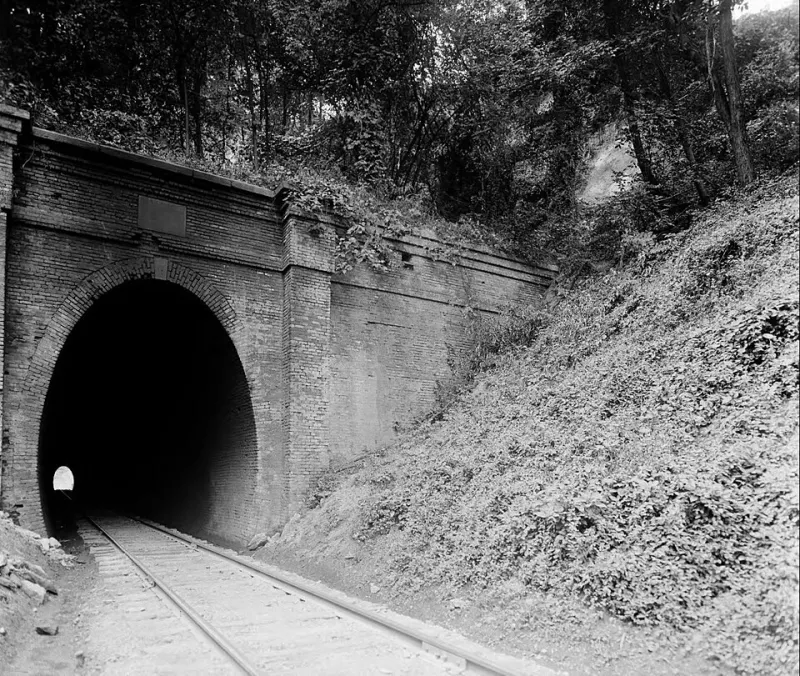
Tunnel Hill, Georgia, carries a layered past. It was a railroad town before it was a battlefield, a civilian community before it was a strategic objective, and a place of ordinary life before it became a subject of historical inquiry. The people who lived and worked there during the Civil War era — and in the decades that followed — left behind a record that is, like all human records, incomplete.
Official documents capture names, dates, and transactions. They do not capture the texture of daily experience: what it meant to live within earshot of a contested tunnel, to watch soldiers pass through a town that was both familiar and suddenly strange, to rebuild a household after the armies moved on. For that texture, historians and heritage professionals must turn to the families who inherited these memories along with whatever else was passed down.
The Tunnel Hill Heritage Center has made the collection of these family narratives a sustained institutional priority. Over the past several years, staff and volunteers have conducted recorded interviews with descendants representing a range of backgrounds — railroad workers' families, farming households, freedmen's descendants, and the descendants of soldiers who passed through or were stationed at the hill. The resulting archive is, by any measure, extraordinary.
Margaret's Quilt and What It Remembers
One of the most quietly affecting contributions to the center's oral history collection came from a woman in her late seventies who drove up from Dalton carrying a cardboard box she had kept in a closet for more than forty years. Inside was a quilt, badly worn at the edges, stitched from fabric scraps that her family had always described as coming from "the war years."
Her great-great-grandmother, according to family tradition, had made the quilt from cloth salvaged after Union troops commandeered the family's stored fabric. The act of salvage — of making something useful and beautiful from what remained after loss — had become, across four generations, a kind of family philosophy. "We don't throw away what can still serve," she explained during her recorded interview. "That's what she taught, and that's what we still believe."
The quilt is now part of the center's artifact collection, on loan from the family. But it is the story attached to it — the specific, irreplaceable account of how it came to exist and what it has meant to the people who kept it — that transforms a textile into a historical document.
The Railroad Men's Families: A Legacy of Skilled Labor
Among the most historically significant oral history contributions have come from families descended from the laborers who maintained and operated the Western & Atlantic Railroad through the Tunnel Hill corridor. These were men whose work was essential to the Confederate supply effort and, later, to the region's postwar economic recovery. Their names appear infrequently in formal records, and their experiences have been correspondingly underrepresented in published histories.
One descendant, a retired schoolteacher whose great-grandfather worked as a section hand on the railroad in the 1870s and 1880s, brought to her interview a collection of tools she had always kept on a shelf in her home without fully understanding their purpose. Heritage center staff identified them as track-maintenance implements of the period. "I knew they were important," she said. "I just didn't know how to explain why."
Her family's oral tradition included detailed accounts of the physical demands of railroad work, the social hierarchies among workers of different skill levels, and the particular pride her great-grandfather took in a stretch of track that he maintained without incident for more than two decades. These are not details that survive in corporate records or government reports. They survive because a family chose to remember them.
Passing Down Memory: How Families Sustain Cultural Knowledge
A recurring theme across the center's oral history interviews is the deliberate, often self-conscious effort families make to transmit historical knowledge to younger generations. This transmission takes many forms: annual gatherings at significant locations, the ritualized telling of particular stories, the careful preservation of objects that anchor memory to material reality.
Several interviewees described taking their own children and grandchildren to Tunnel Hill Heritage Center specifically to connect family stories to a physical place. For these families, the center serves not merely as a repository of community history but as a site of personal pilgrimage — a place where the abstract becomes concrete, where a name mentioned in a family story corresponds to an artifact in a glass case or a location on an interpretive map.
This function of heritage sites as anchors for family memory is well recognized in the field of public history, but it is easy to underestimate how powerful the experience can be for the families involved. One grandfather described bringing his twelve-year-old grandson to the center and watching the boy's expression change when he recognized his family's surname on a historical panel. "He stood there for a long time," the grandfather said. "He didn't say anything. He just stood there."
Why These Voices Belong in the Historical Record
Oral histories have sometimes been treated, within academic and institutional contexts, as supplementary sources — useful for color and context but subordinate to documentary evidence. This hierarchy is increasingly, and rightly, contested. Family narratives preserve categories of historical experience that written records were never designed to capture: emotional reality, social texture, the subjective meaning of historical events to the people who lived through them.
At Tunnel Hill Heritage Center, the working assumption is that a descendant's account of what her ancestor endured and believed and valued is not less historically significant than a military dispatch or a railroad ledger. It is differently significant — and in some respects more so, because it preserves what those official documents systematically excluded.
The center's oral history archive is available to researchers by appointment and continues to grow as new families come forward. For those with connections to the Tunnel Hill community — however distant or uncertain — the center warmly encourages contact. Every story carried forward is a piece of history reclaimed.
These voices have waited long enough. The hill is ready to hear them.