Against the Clock: The Science and Dedication Behind Preserving Tunnel Hill's Historic Structures
Photo: Philip Pankhurst , CC BY-SA 2.0, via Wikimedia Commons
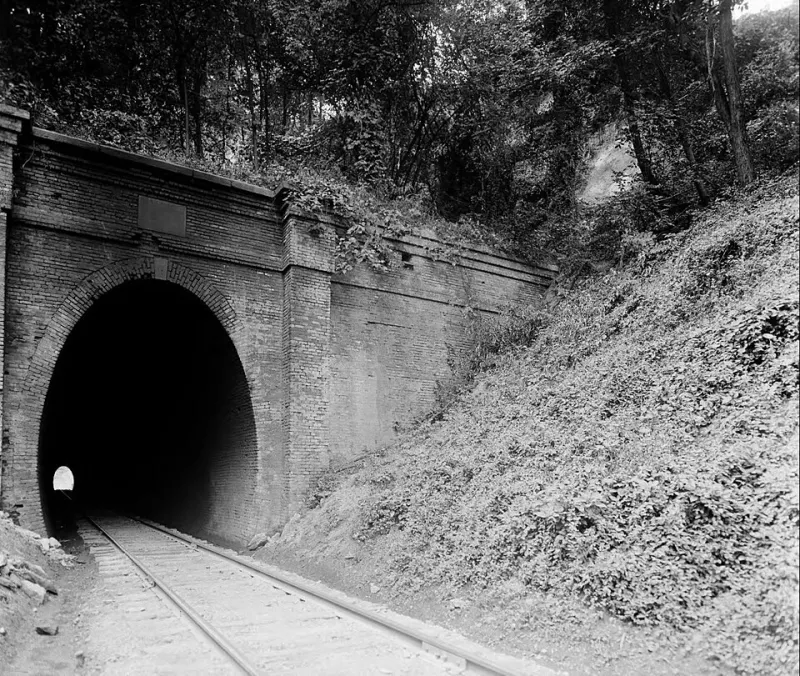
Standing at the entrance to the Tunnel Hill railroad tunnel, it is easy to be struck first by its sheer scale. The bore stretches 1,477 feet through the solid rock of Chetoogeta Mountain—an engineering achievement that was, at the time of its completion in 1850, among the most ambitious undertakings in the American South. What is less immediately visible, but no less impressive, is the ongoing effort required to keep that achievement intact for the generations of visitors and scholars who will follow.
Preservation, it turns out, is never finished. It is a continuous negotiation between human intention and the indifferent forces of time, water, and geology. The team responsible for maintaining Tunnel Hill's historic structures understands this better than anyone.
What 160 Years Actually Does to a Tunnel
To appreciate the complexity of the conservation challenge, it helps to understand what a structure endures over more than a century and a half of existence. The Tunnel Hill bore was constructed primarily of brick and hand-cut stone, materials that were state-of-the-art in the 1840s but that carry inherent vulnerabilities when exposed to the particular stresses of the Tennessee Valley environment.
Seasonal temperature fluctuations cause masonry to expand and contract repeatedly, gradually widening micro-fractures in mortar joints. Groundwater infiltration—a persistent issue given the region's rainfall patterns—accelerates this process while also introducing mineral deposits that can destabilize brick faces over time. The tunnel's interior, never fully dry, sustains biological growth that, left unmanaged, works its way into structural materials with slow but measurable destructive effect.
Add to these natural processes the physical legacy of the Civil War—artillery impacts, deliberate demolition attempts, and the stress of wartime military use—and the conservation team faces a structure that carries the accumulated damage of both human conflict and environmental attrition.
"Every section of the tunnel tells a slightly different story," explained one Heritage Center preservation consultant during a recent site assessment. "What works as a stabilization approach in one area may be entirely inappropriate twenty feet away. You have to read the structure almost like a text."
The Technology Entering the Tunnel
Modern preservation science has provided conservators with tools that earlier generations could scarcely have imagined. Ground-penetrating radar, for instance, allows specialists to map subsurface voids and fracture networks without disturbing the fabric of the structure itself. This non-invasive diagnostic capability is particularly valuable at a site like Tunnel Hill, where archaeological integrity is as important as physical stability.
Photogrammetry—the process of creating precise three-dimensional models from overlapping photographic images—has been deployed to document the tunnel's current condition with millimeter-level accuracy. These digital records serve a dual purpose: they provide conservators with a baseline against which future deterioration can be measured, and they create a permanent archive that would allow the structure to be understood in detail even if physical access were ever compromised.
For consolidation work on deteriorating masonry, the Heritage Center's conservation partners have moved away from Portland cement-based mortars, which were commonly used in 20th-century repair campaigns but are now understood to cause long-term damage by trapping moisture and introducing incompatible expansion rates. Contemporary practice favors hydraulic lime mortars formulated to match the original material's physical properties as closely as possible—a subtler intervention that respects the structure's historical character while providing genuine stabilization.
Archaeology Beneath the Surface
The conservation effort extends well beyond the tunnel bore itself. The broader Tunnel Hill site encompasses earthworks, fortification remnants, and buried features associated with both the railroad construction era and the Civil War occupation of the area. Archaeological monitoring is therefore an integral component of any ground-disturbing work undertaken in the vicinity.
Recent seasons of fieldwork have yielded significant findings. A section of drainage infrastructure associated with the original construction phase was identified during a routine utility survey, prompting a more systematic excavation that documented construction techniques not previously represented in the written record. Artifact assemblages recovered from the site's Civil War-period layers have added nuance to the understanding of daily military life at this strategic location.
Heritage Center staff archaeologist noted that the site continues to generate new questions even as it answers old ones. "The documentary record gives us a framework, but the ground always has something to add," she observed. "That's what makes systematic, careful archaeology so important here. Every season, we learn something that changes how we interpret the physical evidence."
Challenges That Technology Alone Cannot Solve
For all the sophistication of contemporary conservation science, the Heritage Center's preservation team is candid about the challenges that no instrument or technique can fully address. Funding remains the most persistent constraint. Structural stabilization work of the kind required at Tunnel Hill is expensive, labor-intensive, and rarely generates the kind of dramatic visual results that attract immediate donor attention.
Climate variability also presents an evolving challenge. Precipitation patterns in the region have shifted in recent decades, and the tunnel's drainage systems—designed for 19th-century hydrological conditions—require ongoing adaptation to handle water volumes that were not anticipated in the original engineering calculus.
Staffing continuity is a further concern shared by heritage institutions across the country. Specialized preservation skills take years to develop, and the field faces a generational transition as experienced practitioners retire. The Heritage Center has responded in part by partnering with university programs in historic preservation and archaeology, creating field school opportunities that introduce students to the site while building the professional pipeline the discipline requires.
How Visitors Become Stakeholders
One of the Heritage Center's core convictions is that preservation is not solely a technical enterprise—it is a civic one. Visitors who come to Tunnel Hill are not passive observers of history; they are participants in its continuation.
Admission revenue directly supports the operational costs of the site, including the maintenance work that keeps structures accessible and stable. The Heritage Center's membership program provides a recurring funding stream that allows conservation planning to extend beyond single-year budget cycles. Donations to the preservation fund are directed specifically toward structural work and archaeological research, with transparent reporting on how contributions are applied.
Perhaps most valuably, visitors who leave Tunnel Hill with an understanding of what it takes to maintain a site like this become advocates in their own communities—people who support heritage funding at the local, state, and federal levels and who bring others to the hill in turn.
The tunnel has stood for more than a century and a half. With the care and commitment of the people who value what it represents, it will stand for considerably longer. That is, in the end, the purpose of every technical assessment, every carefully mixed mortar batch, and every season of archaeological fieldwork: to ensure that the hill's history remains alive and accessible for those who have not yet arrived to experience it.