Stone, Mortar, and Meaning: What Tunnel Hill's Historic Architecture Tells Us About a Nation in Transition
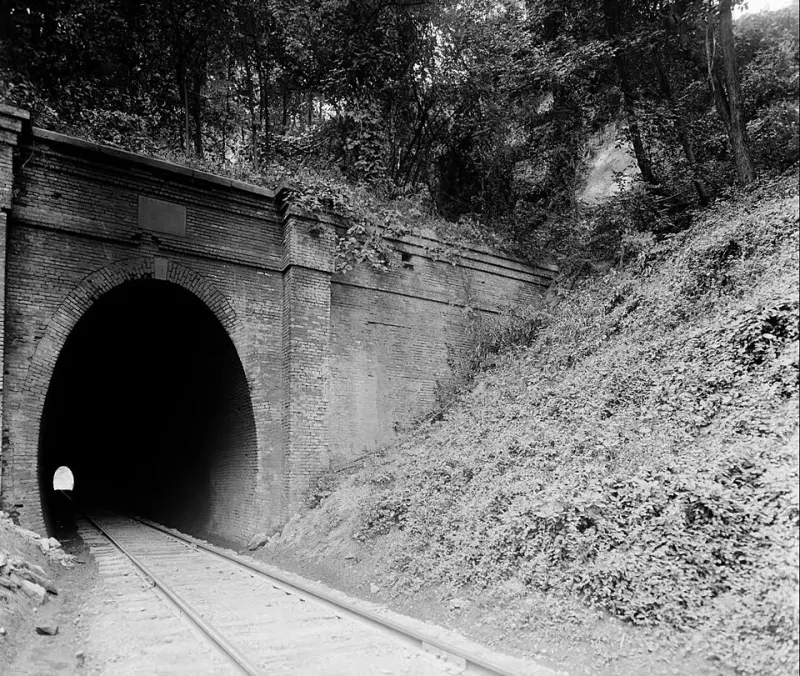
Photo: Holsinger, Rufus W., Public domain, via Wikimedia Commons
There is a particular kind of knowledge that no document can fully convey — the kind written in stone, pressed into mortar, and carved by hand into the living rock of a hillside. At Tunnel Hill, the historic passages and supporting structures that define this landmark are not merely engineering achievements. They are a layered text, one that rewards careful reading with insights into the technological capabilities, economic realities, and human determination that characterized mid-19th-century America.
For visitors who take the time to look closely, every arch, every drill mark, and every variation in masonry tells part of a larger story. And that story, it turns out, is inseparable from the turbulent history of a nation on the verge of fracture.
The Materials Beneath Your Feet
Construction at Tunnel Hill relied primarily on locally quarried limestone and hand-cut sandstone, a choice that reflected both practical necessity and the economic logic of the era. Transporting heavy materials across the rough terrain of northwestern Georgia in the 1840s and 1850s was prohibitively expensive, so builders drew on what the landscape provided. This reliance on regional stone was not unique to Tunnel Hill — it was the defining characteristic of American infrastructure construction throughout the antebellum period.
What distinguishes Tunnel Hill, however, is the precision with which those local materials were worked. Examination of the tunnel's interior lining reveals careful coursing — the deliberate horizontal layering of stone — that speaks to a workforce possessing considerable masonry skill. The joints between stones are tight, an indication that builders understood the compressive forces at work within an arched passage and took pains to minimize weak points. This level of craftsmanship was not accidental. It was the product of training, experience, and, in many documented instances, the forced labor of enslaved workers whose contributions to American infrastructure have only recently begun to receive appropriate scholarly attention.
The Arch as Argument
Perhaps no single feature of Tunnel Hill's construction communicates more about 19th-century engineering philosophy than its arched portals. The semicircular arch was the dominant structural form of the era, borrowed from Roman and Renaissance precedent and adapted to the demands of railroad engineering. At Tunnel Hill, these arches perform several functions simultaneously: they distribute the weight of the hillside above, frame the passage for approaching trains, and announce — with unmistakable architectural intention — that this is a place of consequence.
The decision to invest in finished, dressed stonework at the portal faces, rather than leaving rough-cut rock exposed, reflects the priorities of the Western & Atlantic Railroad's leadership. Railroads in this period were not merely transportation companies; they were symbols of progress, modernity, and regional ambition. A well-finished portal communicated to investors, travelers, and competitors alike that the enterprise was serious, well-funded, and built to last. The architecture was, in a very real sense, a form of corporate communication.
Engineers of the period understood that the arch could span considerable distances without interior supports, making it ideal for tunnel construction. What they could not always control was the variable quality of the surrounding geology. At Tunnel Hill, workers encountered alternating bands of harder and softer rock, a challenge that required constant adjustment of drilling angles and blasting charges. The slight irregularities visible in the tunnel's profile today are not flaws — they are evidence of that ongoing negotiation between human intention and geological reality.
Reading the Drill Marks
For those with a trained eye, the interior surfaces of Tunnel Hill's passages offer something remarkable: a direct record of the construction process itself. Hand-drill marks — the circular impressions left by iron bits driven into rock by hammer and muscle — remain visible in sections where the original stone has not been resurfaced. These marks follow patterns that reveal the sequence of excavation, the spacing of blast holes, and the direction from which workers advanced through the hillside.
The drill patterns also illuminate the division of labor within the construction crew. Experienced drillers, who commanded higher wages and greater respect, worked the face of the tunnel, advancing the passage inch by inch. Behind them, laborers cleared debris, mixed mortar, and set stone — tasks that required less specialized skill but no less physical endurance. This stratified workforce mirrored the broader social hierarchies of antebellum America, with free skilled workers, contracted laborers, and enslaved individuals occupying distinct and unequal positions within the same construction enterprise.
Innovation Under Constraint
The 1840s represented a transitional moment in American engineering. Black powder remained the primary blasting agent — dynamite would not be patented until 1867 — and the mechanical drill had not yet displaced hand tools on most construction sites. Engineers working at Tunnel Hill were therefore operating near the practical limits of available technology, solving problems with ingenuity and improvisation rather than with superior equipment.
One notable adaptation visible at Tunnel Hill involves the drainage systems incorporated into the tunnel floor. Standing water within a railroad tunnel posed serious risks to track integrity and locomotive operation. The builders addressed this by grading the tunnel floor slightly and incorporating drainage channels along the base of the side walls — a straightforward solution that nonetheless required careful planning and precise execution during construction. These channels remain functional today, a quiet testament to the foresight of engineers who understood that a structure's long-term performance depended on managing not just the forces above, but the water below.
A Structure That Spans Two Eras
Tunnel Hill's architecture did not remain static after its initial construction. The Civil War brought new uses and new damage to the structure, and subsequent repairs and modifications layered additional chapters onto its physical history. Visitors examining the masonry closely can sometimes identify areas where repair work — distinguishable by slight differences in stone color, mortar composition, or coursing style — speaks to the structure's role in wartime operations and its survival into the postwar period.
These repairs are not blemishes on an otherwise pristine artifact. They are evidence of continuity, of a community's ongoing investment in a structure that remained central to regional commerce and transportation long after the battles that made Tunnel Hill famous had ended.
Why the Architecture Matters
At the Tunnel Hill Heritage Center, the physical fabric of the historic structures is treated not merely as a backdrop for historical interpretation, but as a primary source in its own right. The stones, arches, and drill marks preserved within these passages carry information that written records cannot fully capture — information about labor, skill, decision-making, and the material constraints that shaped 19th-century American life.
For visitors, engaging with this architecture directly is one of the most powerful ways to connect with the past. Standing within a passage carved by hand from living rock, surrounded by masonry laid by workers whose names history has not always preserved, offers a form of historical understanding that no exhibit panel or documentary film can fully replicate. The hill speaks, if one knows how to listen — and the Tunnel Hill Heritage Center is committed to helping every visitor hear what it has to say.