Where the Past Meets the Pixel: Digital Tools Transforming How Visitors Experience Tunnel Hill
Photo: European Southern Observatory, CC BY 2.0, via Wikimedia Commons
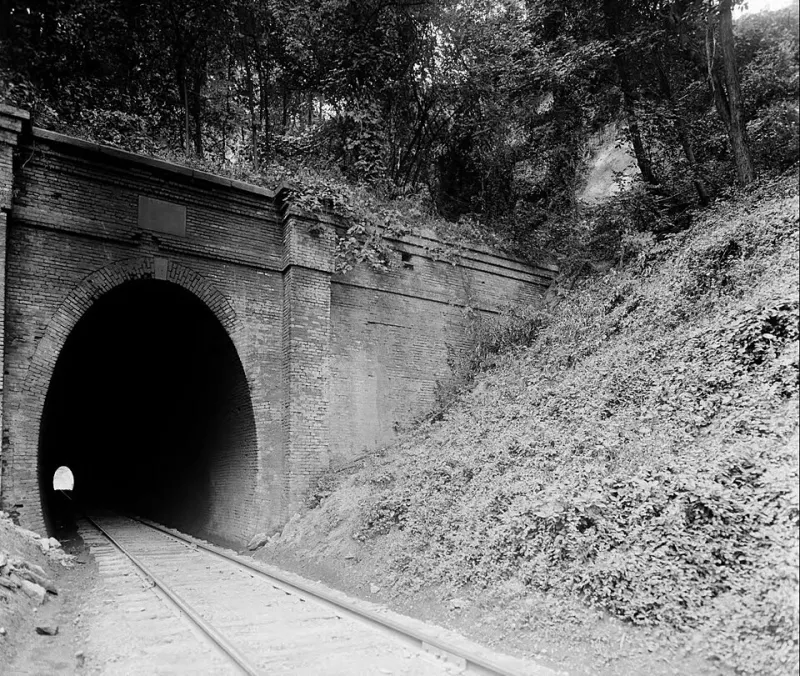
There is a particular stillness that settles over a person standing at the mouth of Tunnel Hill's historic railroad tunnel. The stone walls, worn smooth by generations of weather and touch, carry a weight that no photograph can fully convey. Yet for many visitors arriving at this site for the first time, the landscape they see today bears little visual resemblance to the one that Civil War soldiers, railroad laborers, and community members once navigated. Earthworks have softened. Structures have vanished. The human activity that once animated every corner of this terrain exists now only in records, recollections, and the careful work of preservation professionals.
That gap between what a visitor sees and what once existed is precisely where a new generation of digital heritage tools is making its most compelling contribution.
Rebuilding a Landscape Through Light and Code
Over the past several years, the Tunnel Hill Heritage Center has been quietly integrating digital reconstruction technology into its interpretive programming. Among the most visible of these efforts is an augmented reality application available to visitors on their own smartphones. When a guest points their device toward specific waypoints along the heritage trail, the app overlays period-accurate visual reconstructions onto the present-day landscape — wooden rail cars, period-dressed workers, and the bustling infrastructure of a mid-nineteenth-century railroad corridor appear to inhabit the same space the visitor is standing in.
"The goal was never to replace the physical site," explains one of the center's curatorial staff members who helped develop the interpretive framework behind the app. "It was to give people a visual vocabulary for what they were already sensing. When someone stands in front of that tunnel and understands, even partially, what it looked like and sounded like during the Civil War, their relationship to the stone in front of them changes completely."
The reconstructions themselves were built in close consultation with historians, drawing from period photographs, engineering surveys, and firsthand accounts preserved in regional archives. Every visual element was vetted for accuracy, with the team erring on the side of transparency when the historical record was ambiguous — a practice that itself reflects the center's broader commitment to honest, evidence-based interpretation.
Interactive Mapping as a Tool for Orientation and Discovery
Beyond augmented reality, the Heritage Center has also invested in an interactive digital mapping platform accessible both on-site and through its website. Unlike a standard trail map, this platform layers historical data across the present-day geography of Tunnel Hill, allowing users to toggle between different time periods, explore archival images tied to specific coordinates, and read contextual narratives about individual locations.
For educators bringing student groups to the site, the mapping tool has proven especially valuable. Teachers can assign pre-visit research tasks using the platform, so that students arrive already oriented to the spatial logic of the site's history. On the ground, those same students can then use the interactive map to connect what they researched at home with what they observe in person — a pedagogical bridge that reinforces both digital literacy and historical thinking.
Visitors without formal educational backgrounds have responded with equal enthusiasm. "I've been to a lot of Civil War sites," one recent guest noted in the center's visitor feedback log, "and this was the first time I felt like I actually understood where I was standing in relation to everything that happened here. The map made the whole place make sense."
The Emotional Dimension of Digital Immersion
Skeptics of heritage technology sometimes worry that digital overlays risk turning solemn historical sites into something closer to theme parks — that the introduction of screens and apps will crowd out the reflective silence that genuine historical engagement requires. It is a concern that the staff at Tunnel Hill Heritage Center takes seriously.
The design philosophy behind the center's digital programming reflects a deliberate restraint. The augmented reality app, for instance, does not run continuously. Visitors activate it at specific moments and then return their devices to their pockets. The experience is structured to punctuate the physical visit rather than dominate it. Interpretive signage along the trail consistently encourages visitors to look up from their screens and engage with the textures, sounds, and scale of the site itself.
"We think of the technology as a conversation starter," says a member of the Heritage Center's education team. "It gives people something to react to, something to question. And then they put the phone down and they're just standing there, in the actual place, with all of that context alive in their minds. That's when the real connection happens."
That philosophy appears to be working. Post-visit surveys conducted over the past two years consistently indicate that guests who engaged with the digital tools reported higher levels of emotional connection to the site — not lower — than those who relied solely on traditional signage and printed materials.
Virtual Access for Those Who Cannot Visit in Person
One of the less-discussed benefits of the center's digital investment is the accessibility it creates for audiences who may never set foot on the hill itself. The Heritage Center has developed a series of virtual reconstructions and narrated digital tours available through its website, designed for classroom use, for researchers working remotely, and for individuals whose mobility or geographic circumstances make an in-person visit impractical.
These virtual offerings are not intended as substitutes for the physical experience — the center is candid about that distinction — but they represent a meaningful extension of the site's educational mission. A high school student in rural Montana researching the Civil War's impact on Southern infrastructure can now engage with Tunnel Hill's story in a way that would have been impossible a decade ago.
Preservation in the Age of the Algorithm
There is a certain irony in using cutting-edge digital technology to preserve a landscape shaped by nineteenth-century engineering. But the staff at Tunnel Hill Heritage Center sees no contradiction in the pairing. Technology, they argue, has always been a tool in service of human understanding — the same impulse that drove laborers to blast through solid rock with black powder in the 1840s now drives archivists to encode historical data into geospatial platforms in the 2020s.
What remains constant across that span of time is the underlying ambition: to move people, to connect them with something larger than themselves, and to ensure that what happened on this hill is never simply forgotten.
For visitors planning a trip to the Tunnel Hill Heritage Center, the digital tools described here are available through the center's website and on-site kiosks. Staff members are on hand to assist with app navigation and to provide the human context that no algorithm, however sophisticated, can fully replicate.