From Transits to Terabytes: How Civil War-Era Innovation Quietly Endures at Tunnel Hill

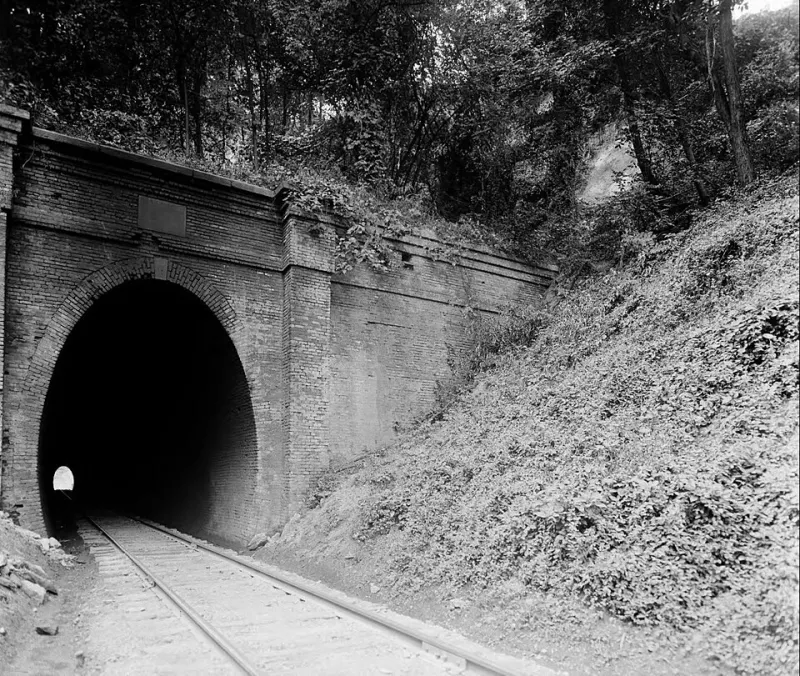
Photo: Tablelegs6, CC0, via Wikimedia Commons
When visitors walk through the grounds of Tunnel Hill Heritage Center, they are often struck by the visible weight of history — the worn stonework, the contours of earthworks, the commanding presence of the tunnel itself. What is less immediately apparent, however, is the invisible thread connecting the engineering sensibilities of the 1860s to the preservation practices of the present day. That thread, once traced, reveals a story as compelling as any battlefield account.
The Surveyor's Eye: Precision as a Founding Principle
Building and defending Tunnel Hill required an extraordinary degree of spatial precision. Military engineers and railroad surveyors alike relied on optical transits, chain measurements, and triangulation techniques that, by modern standards, appear rudimentary. Yet the accuracy achieved by these methods was remarkable. The Western & Atlantic Railroad tunnel — bored through solid rock using hand-cut survey lines — deviated only marginally from its intended axis over its full length.
This commitment to measurable accuracy was not incidental. It was a professional ethic born of necessity. A miscalculated fortification angle could expose troops to flanking fire. An imprecise tunnel bore could mean months of costly correction. The surveyors who worked this terrain understood that precision was not a luxury but a condition of survival.
Today's preservation engineers at Tunnel Hill operate within that same disciplinary tradition, though their instruments have changed dramatically. Ground-penetrating radar, LiDAR scanning, and photogrammetric modeling now accomplish in hours what once required weeks of fieldwork. Yet the underlying logic — measure accurately, document thoroughly, disturb minimally — is philosophically identical to the surveyor's creed of the 19th century.
Signal Systems and the Roots of Networked Communication
Civil War-era signal corps operations at strategic positions like Tunnel Hill introduced something genuinely novel to American military practice: real-time, networked communication across terrain. The wig-wag flag system and early telegraph lines created a web of information exchange that allowed commanders to coordinate responses to threats with unprecedented speed.
The conceptual architecture of those signal networks — redundancy, relay stations, standardized codes — would not look entirely foreign to a modern network engineer. The principle of transmitting encoded information across distributed nodes, subject to interference and requiring verification protocols, maps onto contemporary digital communication in ways that are more than merely metaphorical.
For heritage documentation specialists, this historical precedent carries practical meaning. The digital networks used to archive Tunnel Hill's records — connecting on-site databases with regional repositories and national registries — embody the same logic of distributed, redundant information preservation. When a conservator uploads a high-resolution scan of a recovered artifact to a shared cloud archive, she is, in a meaningful sense, running a signal relay.
Construction Materials and the Long Memory of Stone
The masonry and earthwork construction methods employed at Tunnel Hill during the Civil War era reflected both the material constraints and the engineering knowledge of the period. Dry-laid stone, compacted earthen berms, and lime mortar joints were not chosen arbitrarily. They were selected because local craftsmen understood how those materials behaved under load, under weather, and under the particular stresses of the Georgia landscape.
That embodied material knowledge did not disappear with the 19th century. It was preserved, imperfectly but persistently, in the structures themselves. When modern conservators undertake stabilization work at Tunnel Hill, one of their first obligations is to analyze original construction methods before introducing any intervention. Understanding how a Civil War-era mason laid stone — the coursing pattern, the mortar composition, the drainage logic — is essential to repairing that work without compromising its structural integrity or its historical authenticity.
This is not mere sentiment. The Secretary of the Interior's Standards for the Treatment of Historic Properties, which guide preservation work at federally recognized sites, explicitly require that interventions be reversible and compatible with original materials. In practice, this means that the 19th-century engineer's material choices actively constrain and inform what a 21st-century conservator may do. The past, in this sense, retains authority over the present.
Digital Heritage Documentation: A New Chapter in an Old Tradition
Perhaps the most striking parallel between Civil War-era technology and contemporary preservation practice lies in the domain of documentation itself. Military cartographers of the 1860s understood that a battle, once fought, could only be reconstructed through the records left behind. Maps, after-action reports, photographic daguerreotypes, and engineering drawings were all forms of institutional memory — attempts to fix a moment in time against the erosion of forgetting.
The digital documentation methods now employed at Tunnel Hill Heritage Center serve precisely the same function, with vastly greater fidelity and permanence. Three-dimensional laser scans capture the precise geometry of structural elements that may be decades away from critical deterioration. Multispectral imaging reveals inscriptions and surface details invisible to the naked eye. Oral history recordings, georeferenced photographs, and digitized archival documents are assembled into layered databases that allow researchers to interrogate the site without physically disturbing it.
This shift toward digital stewardship does not represent a departure from historical practice so much as its logical extension. The impulse to record, preserve, and transmit — to ensure that what was built and experienced is not simply lost — is as old as the site itself.
Why This Continuity Matters to Visitors
For the visitor standing at the entrance to Tunnel Hill Heritage Center, the connection between 19th-century engineering and 21st-century preservation may seem abstract. It need not be. Every stabilized wall, every interpretive map, every digitized photograph on display in the center's galleries is the product of a dialogue between past and present that spans more than 150 years of accumulated knowledge.
Understanding that dialogue enriches the experience of the site. Tunnel Hill is not simply a place where history happened. It is a place where history is actively maintained — where the intellectual traditions of an earlier era of innovation continue to shape how we understand, protect, and share a shared American story.
The machines have changed. The mission has not.