Pickaxes, Powder, and Perseverance: The 19th-Century Engineering Genius That Built Tunnel Hill
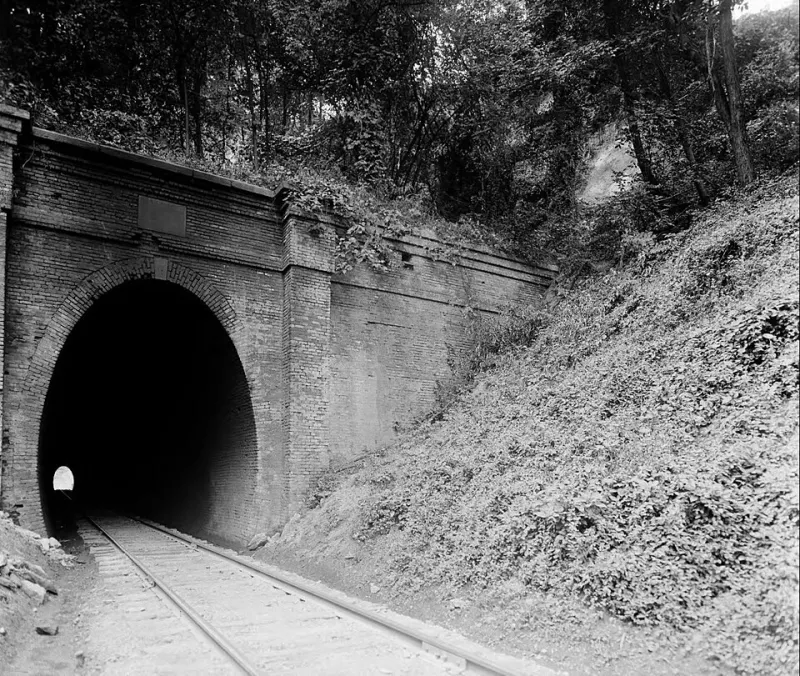
Photo: Holsinger, Rufus W., Public domain, via Wikimedia Commons
When visitors descend into the cool, dimly lit passages beneath Tunnel Hill, they often remark on the uncanny sense that time has compressed. The rough-hewn walls, the precise curvature of the bore, the subtle gradations carved into stone — each detail whispers of a workforce that labored under extraordinary pressure, with tools that would seem primitive by contemporary standards. Yet what those workers accomplished was, by any measure, a genuine feat of engineering.
To understand how these tunnels came to exist, one must first appreciate just how formidable the challenge was. The Western & Atlantic Railroad tunnel at Tunnel Hill, completed in 1850 and later drawn into the theater of Civil War operations, required its builders to confront geology, logistics, and the limits of human endurance all at once. The methods employed were neither simple nor improvised — they reflected a sophisticated, if demanding, approach to underground construction that had been evolving throughout the early industrial era.
Reading the Rock: Geological Challenges Beneath the Hill
Structural historians who have studied the site note that the ridge through which the tunnel passes presented a complex mix of sedimentary and metamorphic rock formations. Workers could not simply adopt a single excavation strategy and apply it uniformly. Instead, foremen and engineers had to read the rock face continuously, adjusting their approach as conditions shifted from one section of the bore to the next.
In sections where the stone was relatively soft, laborers advanced quickly using hand-drilled bore holes packed with black powder charges. The blast would fracture a section of rock, after which teams with pickaxes, shovels, and hand carts would clear the debris — a process known as "mucking" — before the cycle repeated. In harder formations, progress slowed dramatically. A crew might advance only a few feet per day, drilling each bore hole by hand in a grueling rotation where one worker held the drill steel while another struck it repeatedly with a hammer, turning the bit a quarter rotation between blows to prevent binding.
Archaeological assessments of the tunnel's interior walls reveal evidence of these varied techniques. Tool marks preserved in stone tell a layered story: the parallel scoring of hand drills, the irregular fracture patterns left by powder charges, and the smoothing work performed by finish crews who shaped the bore to its final profile.
The Workforce Behind the Work
The labor force that constructed and later maintained the Tunnel Hill passage was neither uniform nor small. During the original railroad construction phase, the project drew on a combination of immigrant laborers — many of them Irish workers who had gained tunnel-driving experience in the Northeast — and enslaved African Americans whose compelled labor was woven into the economic fabric of antebellum Georgia infrastructure projects.
Historians who have examined payroll records and contractor accounts from the period note that the division of labor was highly stratified. Skilled drillers and blasting experts, often European immigrants with mining backgrounds, commanded the most technically demanding tasks. Behind them came larger crews responsible for removing broken rock, shoring up unstable sections with timber supports, and maintaining the ventilation systems that kept working conditions survivable.
Ventilation, in fact, was among the most persistent engineering concerns. Black powder blasting produced thick clouds of acrid smoke, and without adequate airflow, workers faced not only discomfort but genuine risk of asphyxiation. Ventilation shafts drilled from the surface provided some relief, but their placement and sizing required careful calculation. Contemporary accounts describe workers occasionally being forced to abandon a section for hours at a time while smoke cleared — a costly delay in a project already running against tight deadlines.
Civil War Adaptation: When Military Necessity Drove Innovation
When the Civil War transformed Tunnel Hill from a railroad landmark into a strategic military objective, the tunnel's engineering significance took on new dimensions. Both Union and Confederate forces recognized the passage as a critical chokepoint along the Western & Atlantic line — a supply artery that could determine the outcome of entire campaigns.
Military engineers on both sides were tasked with assessing, fortifying, and at times deliberately damaging the structure to deny its use to the enemy. Confederate engineers, working under significant resource constraints, developed improvised methods for reinforcing the tunnel's portals and approaches against artillery bombardment. Union engineers, for their part, conducted rapid structural assessments to determine whether the tunnel could support the passage of heavily loaded supply trains without risk of collapse.
These wartime adaptations required a working knowledge of masonry, load distribution, and soil mechanics that many military engineers had acquired through formal training at institutions such as West Point, where engineering curricula had been heavily influenced by French technical education. The intersection of academic engineering theory and field improvisation produced solutions that, in some cases, extended the functional life of the tunnel well beyond what its original builders might have anticipated.
What the Walls Still Tell Us
Modern structural historians and preservation engineers who have studied the Tunnel Hill site emphasize that the physical fabric of the tunnel itself remains one of the richest primary sources available. Unlike documents that can be lost, altered, or misinterpreted, the stone and mortar of the bore record decisions made in real time by real workers facing real constraints.
Measurements of drill-hole spacing, for example, allow researchers to reconstruct the blasting patterns used in specific sections, offering insight into the skill level and experience of the crews who worked there. Variations in mortar composition within the lining masonry suggest multiple phases of repair and reinforcement, each corresponding to a different period in the tunnel's history. Even the geometry of the bore — its slight asymmetries and localized corrections — speaks to the challenges of maintaining alignment without modern surveying instruments.
For visitors to the Tunnel Hill Heritage Center, these details transform what might otherwise seem like a simple passage through rock into a richly layered historical document. Every irregularity in the wall, every change in stone color or texture, represents a decision made by someone long gone — a driller adjusting for a fault line, a mason compensating for a crumbling section, an engineer choosing pragmatism over perfection under the pressure of war.
Honoring the Builders
It would be a disservice to the full history of this site to discuss its engineering solely in terms of methods and materials without acknowledging the human cost embedded in those walls. Many of the men who built and maintained these tunnels labored without recognition, compensation, or choice. Their technical contributions were real and consequential, even when the historical record has failed to preserve their names.
The Tunnel Hill Heritage Center remains committed to presenting this history in its full complexity — celebrating genuine ingenuity while honestly confronting the conditions under which that ingenuity was extracted. The tunnels beneath this hill are monuments to what human beings can accomplish, and to the importance of remembering exactly who those human beings were.
When you stand inside these passages and look up at the curved stone ceiling overhead, consider the hands that shaped it — and let that consideration deepen your appreciation for everything this place represents.