Nodes in the Network: How Tunnel Hill Fit Into the Civil War's Broader Underground Web
Photo: Internet Archive Book Images, No restrictions, via Wikimedia Commons
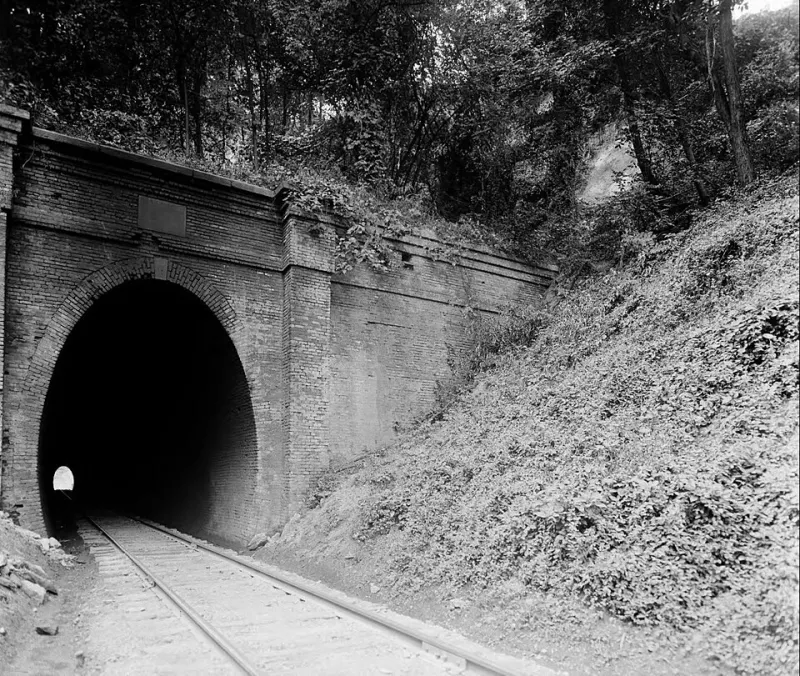
For generations, visitors to Tunnel Hill have arrived with a clear mental picture: a single, dramatic bore cut through a Georgia mountain, engineered to carry railroad traffic and later contested by opposing armies. That image is accurate, as far as it goes. But it is also incomplete. Recent scholarship and archival excavation—both literal and figurative—suggest that Tunnel Hill's significance cannot be fully appreciated in isolation. It was, in the language of modern logistics, a node: one carefully positioned point within a far larger network of underground passages, concealed routes, and subterranean infrastructure that shaped the outcome of the Civil War in the Western Theater.
Rethinking the Map
The conventional heritage narrative tends to treat Civil War tunnels as individual achievements, each one a monument to 19th-century engineering ambition. What that framing obscures is the degree to which military planners on both sides understood these passages as interdependent assets. Union and Confederate commanders alike recognized that controlling a tunnel meant controlling the flow of troops, supplies, and intelligence across entire corridors of terrain.
Historian Dr. Margaret Hollis, whose ongoing research at Emory University focuses on wartime infrastructure in the Deep South, frames the issue plainly. "When you study the operational records from the Army of the Tennessee alongside Confederate quartermaster correspondence, you stop seeing individual tunnels and start seeing a system," she explains. "Tunnel Hill was not merely a geographic obstacle or a prize to be captured. It was a switching point—functionally and strategically—within a much broader logistical architecture."
Archival records held at the National Archives in Atlanta and at several state historical societies corroborate this view. Supply manifests, engineer field reports, and captured Confederate dispatches from 1863 and 1864 reference coordinated use of multiple underground and semi-concealed passages stretching from northern Georgia into Tennessee and Alabama. Tunnel Hill appears repeatedly in these documents not as a terminus but as a waypoint.
The Passages Beyond the Hill
Among the lesser-documented connections is a series of drainage culverts and reinforced earthworks along the Western & Atlantic Railroad corridor that were modified during the war to allow covert movement of small units and messenger traffic. Archaeological surveys conducted in the early 2000s near Dalton, Georgia, identified structural anomalies consistent with deliberate wartime modification of pre-existing civilian infrastructure. While none of these passages rival Tunnel Hill in scale or ambition, their proximity and documented use suggest a deliberate integration into the same operational planning.
Further north, in Tennessee, the tunnels at Cowan and at Tantallon—both on the Nashville & Decatur Railroad—served analogous functions. Union engineers who had studied the construction methods at Tunnel Hill applied similar techniques when reinforcing these passages against Confederate sabotage. The engineering knowledge, in other words, traveled the same routes as the trains.
Archaeologist James Pruitt, who has conducted fieldwork at multiple sites across the region, notes that physical evidence of this connectivity is still being uncovered. "We find tool marks, mortar compositions, and drainage configurations that are almost identical across sites separated by a hundred miles," he says. "That kind of consistency doesn't happen by accident. It tells you that the same engineers, or at least the same engineering doctrine, was at work across the whole corridor."
Intelligence, Communication, and the Subterranean Landscape
Beyond the movement of men and materiel, underground routes served a quieter but equally consequential purpose: the transmission of intelligence. Courier networks operating during the Atlanta Campaign made extensive use of terrain features—ravines, creek beds, and tunnel approaches—to move dispatches without exposure to enemy observation. Tunnel Hill's eastern portal, which offered concealment from the ridge above, is referenced in at least three Union scouting reports as a preferred assembly point before reconnaissance missions deeper into Confederate-held territory.
This dimension of the site's history is one that the Tunnel Hill Heritage Center has worked to incorporate into its interpretive programming in recent years. Visitors who engage with the center's guided tour experience now encounter primary source excerpts—projected alongside scale maps of the broader theater—that situate the tunnel within its operational context. The goal, as the center's curatorial staff describes it, is to move beyond the "single landmark" model and help guests understand the site as one element of a living, dynamic military geography.
What Remains to Be Found
Perhaps the most compelling aspect of this emerging historical picture is how much of it remains unresolved. Portions of the tunnel system's secondary passages have never been formally surveyed. Landowner restrictions, terrain challenges, and limited funding have kept several promising sites off-limits to systematic archaeological investigation. Historians working in this area are candid about the gaps.
"We are working with fragments," Dr. Hollis acknowledges. "The documentary record was deliberately incomplete—both sides had obvious reasons not to write down everything they were doing underground. And the physical record has been compromised by 160 years of weather, agriculture, and development. But the fragments we do have are coherent enough to be persuasive."
For the Tunnel Hill Heritage Center, this incompleteness is itself an interpretive opportunity. Ongoing partnerships with regional universities and the Georgia Department of Natural Resources support continued research, and the center maintains an active relationship with the broader preservation community to ensure that new findings are incorporated into public programming as they emerge.
Visiting With New Eyes
For visitors planning a trip to Tunnel Hill, this expanded understanding of the site's place within a regional network offers a richer framework for the experience. Standing at the tunnel's entrance, it is worth pausing to consider not just the engineering feat visible in front of you, but the invisible web of connections radiating outward—to Dalton, to Chattanooga, to the depots and dispatch riders and supply chains that made the Western Theater's campaigns possible.
The hill itself has not changed. But the history it holds is larger than it first appears.