Strangers Who Stayed: The European Immigrant Workers Who Shaped Tunnel Hill and Never Left

The historical record has always been generous to engineers. Their names appear on plaques, in dedication speeches, and in the kind of institutional memory that survives long after the last participant is gone. The men who swung the picks and hauled the rubble, however, have rarely received the same courtesy. At Tunnel Hill, a quiet but determined effort is underway to correct that imbalance—and in doing so, to restore a chapter of American immigrant history that has long gone undertold.
The Workforce Behind the Achievement
When construction crews descended upon Tunnel Hill during the mid-nineteenth century, they brought with them a workforce that was, in composition, a rough cross-section of the Atlantic migration experience. Irish laborers, many of them displaced by famine and economic collapse at home, constituted the earliest and largest cohort. They were joined in subsequent years by Italian immigrants fleeing poverty in the Mezzogiorno, and later by workers from Poland, Hungary, and Slovakia—men who had crossed an ocean in search of wages that, while modest by any standard, represented something their home countries could not offer: a foothold.
Payroll ledgers preserved in the Tunnel Hill Heritage Center's archival collection reveal surnames that read like a map of nineteenth-century emigration: Flanagan, Moran, Esposito, Kowalski, Novak. Most entries record little beyond a name, a daily wage, and occasional notations about injury or absence. Yet even within these sparse documents, patterns emerge that allow researchers to reconstruct the social geography of the workforce with surprising specificity.
A Community Built Alongside the Construction
What distinguishes the Tunnel Hill labor story from similar accounts at comparable infrastructure sites is the degree to which immigrant workers did not simply pass through the region. Many stayed. The communities they established in the surrounding area—informal at first, then increasingly structured around churches, mutual aid societies, and ethnic fraternal organizations—left an imprint on the local landscape that persisted well into the twentieth century.
Irish workers were among the first to establish permanent households in the vicinity of the construction site. Catholic parishes founded during the construction era served as anchoring institutions, providing not only spiritual sustenance but also practical networks of employment referral and financial assistance. Oral histories collected by the Heritage Center over the past two decades include accounts from descendants of these original parishioners, some of whom can trace their family's presence in the region directly to a great-great-grandfather who arrived with a shovel and a letter of introduction to a labor contractor.
Italian workers, who arrived in greater numbers during the later phases of construction and maintenance, brought with them a distinct set of cultural practices that gradually became woven into the community fabric. Feast day celebrations, particular culinary traditions, and the establishment of Italian-language mutual aid societies all contributed to a pluralistic local identity that often surprises visitors unfamiliar with the region's demographic history.
The Physical Toll and the Silence That Followed
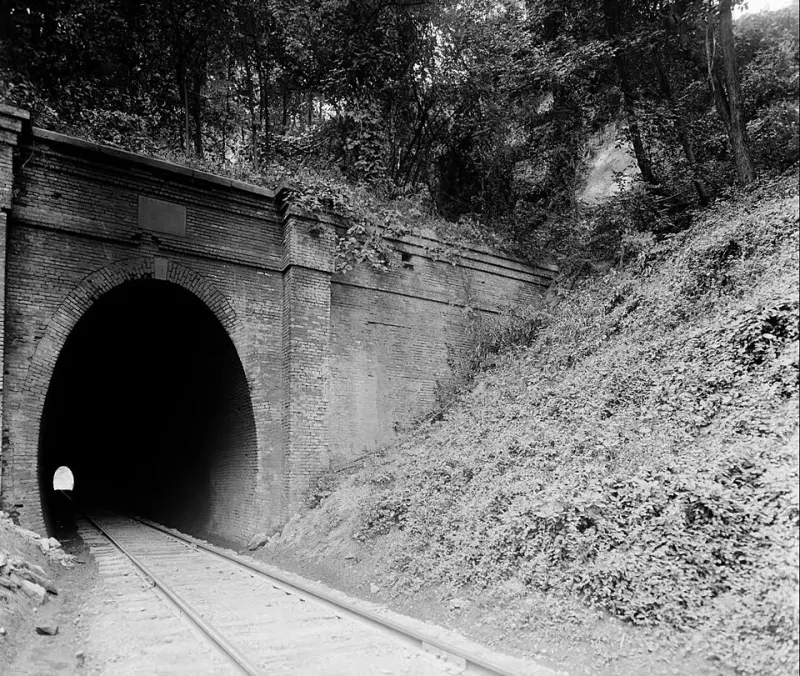
The work itself was extraordinarily dangerous. Tunnel construction in the nineteenth century relied on black powder blasting, hand-drilling through solid rock, and the removal of debris under conditions that offered minimal protection from collapse, flooding, or toxic air. Accident records held in the Heritage Center's collection document fatalities and serious injuries with a clinical brevity that only deepens their impact upon reflection. A notation reading "J. Sullivan—killed, roof fall, Section 4" represents the entirety of an official acknowledgment for a man who may have left behind a family with no recourse and no compensation.
For many immigrant families, the silence that followed a workplace death was compounded by legal and linguistic barriers that made any form of redress effectively impossible. Workers who did not speak English fluently had limited access to legal counsel, and the labor protections that later generations would come to regard as standard did not yet exist. The Heritage Center's ongoing research into this dimension of the Tunnel Hill story has contributed to broader scholarly conversations about the origins of American labor law and the immigrant communities whose suffering helped catalyze reform.
Descendants Speak
Perhaps the most affecting element of the Heritage Center's recent preservation work has been its systematic effort to locate and interview descendants of the original immigrant workforce. These conversations, conducted over several years by staff researchers and volunteer oral historians, have yielded a body of testimony that resists easy summarization.
One descendant of an Irish laborer, now in her seventies and a lifelong resident of the region, described her family's oral tradition surrounding Tunnel Hill with a mixture of pride and sorrow that seemed entirely appropriate to the subject. "My grandmother always said her father helped build the tunnel," she recalled, "but she said it quietly, like it was something that had cost him something he never got back." Her account echoed those of other descendants who described a generational ambivalence—pride in the physical achievement, grief over the conditions under which it was accomplished, and a persistent frustration that the workers' contributions had never been formally acknowledged.
A descendant of Slovak immigrants offered a different perspective, one shaped by the particular history of Eastern European migration to the United States. His great-grandfather had arrived speaking no English and had found work at Tunnel Hill through a labor contractor who operated a system that, in his words, "wasn't much better than indentured servitude." Yet within a generation, the family had established itself, acquired property, and sent children to school. "The tunnel was the beginning for us," he said. "It was hard and it was unfair, but it was the beginning."
Reclaiming a Name at a Time
The Tunnel Hill Heritage Center has made the recovery of immigrant worker identities a formal institutional priority. An ongoing digitization project is making payroll records, company ledgers, and naturalization documents accessible to researchers and descendants alike through the Center's online archive. Staff historians are cross-referencing these records with census data, church baptismal registers, and immigration manifests in an effort to build comprehensive biographical profiles for as many workers as the documentary record will allow.
A permanent interpretive exhibit dedicated to the immigrant workforce is currently in development and is expected to open to visitors within the coming year. The exhibit will incorporate archival photographs, artifact displays, and recorded oral history excerpts, presenting the labor story of Tunnel Hill not as a footnote to the engineering narrative but as a central chapter in its own right.
For visitors who come to Tunnel Hill drawn by the romance of nineteenth-century engineering, the immigrant labor story offers something the technical history alone cannot: a human scale. The tunnel was not built by an abstraction called "labor." It was built by men with names, with families, with fears and ambitions that were recognizably American even before they had learned the language. Reclaiming their story is not merely an act of historical correction. It is an act of acknowledgment long overdue.