Postcards, Pennants, and Penny Candy: A Century of Souvenirs From the Hill's Own Back Room
Behind the exhibits at Tunnel Hill Heritage Center, in a room most visitors never see, there is a shelf that functions as something like an accidental museum of museums. It holds the merchandise — or rather, the merchandise of a century ago, donated back to us by families who found these objects too meaningful to discard.
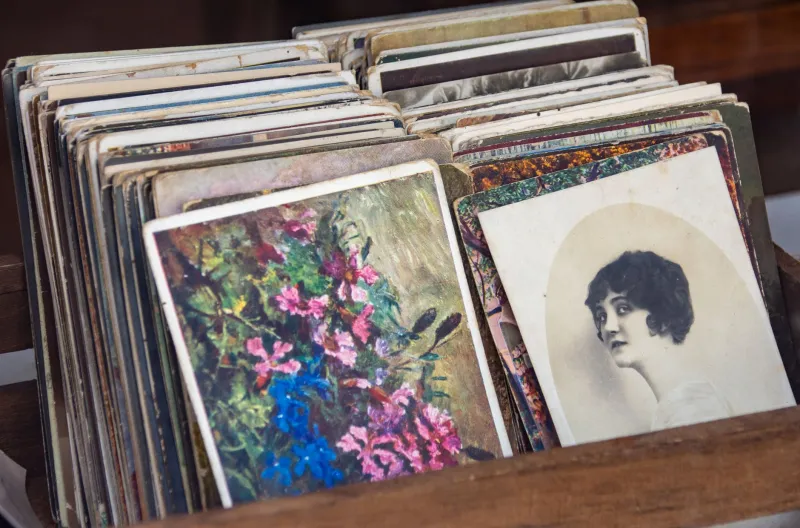
A felt pennant, its colors still startlingly saturated, reading TUNNEL HILL in block letters. A linen postcard, postage canceled in 1911, showing the tunnel mouth rendered in a hand-tinted wash of green and rose. A tin spoon, a celluloid pin, a small glass vial of what the label optimistically calls 'Genuine Hill Sand.'
Taken individually, these are curiosities. Read together, they form a remarkably candid record of what American travelers wanted to remember — and what they thought a place like this was worth.
The Pennant Era: When a Souvenir Was a Banner
The oldest pieces in our back-room collection date from roughly 1905 through the 1920s, and they announce themselves loudly. Pennants, porcelain plates, and embossed postcards dominated the era, and their style tells you everything about the confidence of early American tourism.
This was the age when a souvenir did not whisper. It proclaimed. A visitor to Tunnel Hill in 1912 wanted the folks back home to know, without ambiguity, where they had been. The typography was bold, the colors were saturated, and the sentiment was straightforward: I stood at this tunnel, and it mattered.
There is something touching about the economy of these objects, too. Most were inexpensive — a nickel, maybe a dime — because the travelers buying them were often not wealthy. Railroad excursion culture made day trips accessible to working families, and the souvenir counter met them at their price point. The pennant was the democratization of memory.
The War Years and the Great Simplification
The 1940s section of our collection is noticeably sparser, and the objects themselves are lighter, smaller, and plainer. Wartime material rationing reached into every corner of American commerce, including the humble souvenir stand.
What survives from those years is often paper: postcards printed on thinner stock, matchbooks, small booklets. Yet these modest items carry surprising weight. One postcard in our archive, sent in 1943, contains a single line from a soldier passing through by rail: 'Saw the tunnel today. Thinking of you.' The souvenir was no longer the object. The souvenir was the message it carried.
It is a reminder, for those of us who work in heritage interpretation, that the value of an item has never really lived in the object itself. It lives in the act of remembering.
The Roadside Boom: Salt Shakers, Spoons, and the Automobile
After the war, America got in its car, and souvenir culture changed with it. The postcard rack grew. So did the trinkets.
Our collection from the 1950s and 1960s is the most exuberant of the lot: souvenir spoons with the tunnel rendered in miniature enamel, salt-and-pepper shakers shaped like locomotives, ashtrays, thimbles, and a small plastic bank shaped like a depot that, when a coin was inserted, produced a whistle of questionable accuracy and unshakable charm.
This was souveniring as playfulness. The postwar traveler was on vacation, properly on vacation, and the objects they bought reflected a country in a lighthearted mood. Design historians note the era's love of chrome, bright plastics, and cartoon proportions, and our back-room shelf confirms it.
But there is a quieter story in these objects as well. Many were made in American factories — in Ohio, in Pennsylvania, in New England — and their labels proudly said so. The souvenir was a small node in a vast domestic manufacturing economy, and buying one was itself a small act of mid-century identity.
What the Shelf Says About Us
Lay the whole century out on a table, as our archivists did last spring, and patterns emerge that no single object reveals.
The early era bought announcements. The war years bought messages. The postwar decades bought whimsy. And each generation, without meaning to, documented its own values — its price points, its aesthetics, its manufacturing base, its mood.
It raises an honest question for those of us who operate the modern gift shop: what will our shelf say about us? Our current merchandise leans toward handmade goods, locally sourced prints, books from regional authors, and reproductions of archival photographs. We like to think it reflects a contemporary American value — authenticity — but we suspect a curator in 2075 may read it differently, and we have made peace with that.
Commerce and the Authenticity Question
Every heritage site wrestles with the tension between the register and the mission. A gift shop pays for roof repairs and school-bus field trips; it can also, if handled carelessly, cheapen the very history it funds.
Our approach has been simple to state and difficult to practice: sell only what teaches. Every item in our shop connects to something a visitor can see, touch, or learn on the Hill. The reproduction postcards are printed from our own archive. The books are researched by people who walk this ground. Even the small things — the magnets, the pencils — carry images drawn from our collections rather than generic railroad clip art.
The pennant sellers of 1912, we suspect, would recognize the impulse. They were not selling felt and thread. They were selling the pleasure of having been here, of having witnessed something worth remembering.
A century later, the objects come back to us — donated in shoeboxes and album pages by families who understood what they had. We display a rotating selection in the visitor center, alongside the postcards' original messages, because the handwriting is often the best part.
Come see the shelf. And when you stop by the shop on your way out, know that you are participating in the same century-old ritual: deciding what piece of the Hill is worth carrying home.